Refrigerator Not Cooling but Freezer Works? Here’s Why
If your refrigerator is not cooling but the freezer is still working, the problem is often related to airflow, frost buildup, or a failed component rather than the compressor. Our Westminster refrigerator repair team diagnoses common causes such as frozen evaporator coils, failed evaporator fans, blocked air ducts, and stuck dampers.
Freezer Works but Refrigerator Is Not Cooling.
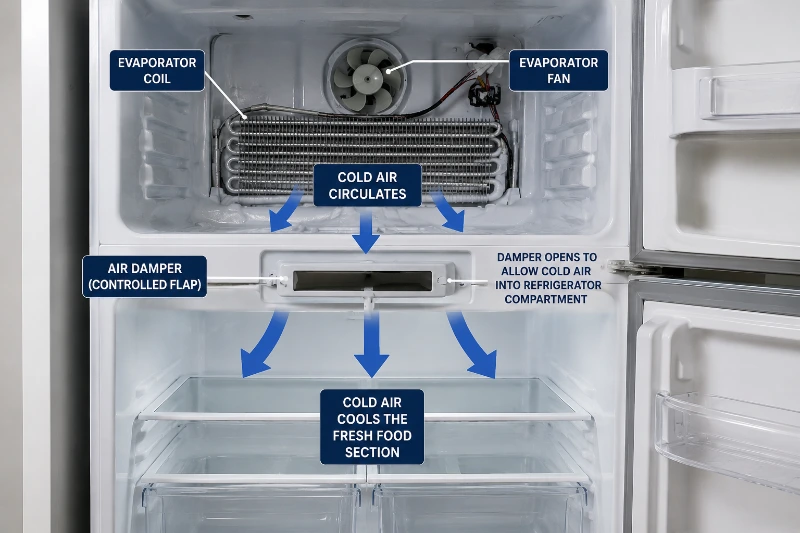
On nearly every standard refrigerator — top-freezer, bottom-freezer, side-by-side — there’s one primary cooling source: the evaporator coil, tucked behind a panel in the freezer compartment.
Cold air gets pulled from the freezer into the fresh food section through a duct system, pushed along by a small fan and metered by a damper (sometimes called an air control or diffuser).
When that pathway breaks down anywhere along the line, the freezer keeps doing its job while the fridge side slowly climbs toward room temperature.
“Freezer cold, fridge warm” does not automatically mean the compressor is shot. It often means something between the freezer and refrigerator compartment has stopped moving cold air where it needs to go.
What’s the Most Common Cause of This Specific Problem?
In my experience going on these calls around Westminster and the surrounding area, here’s what tends to be behind it:
Frozen-Over Evaporator Coil
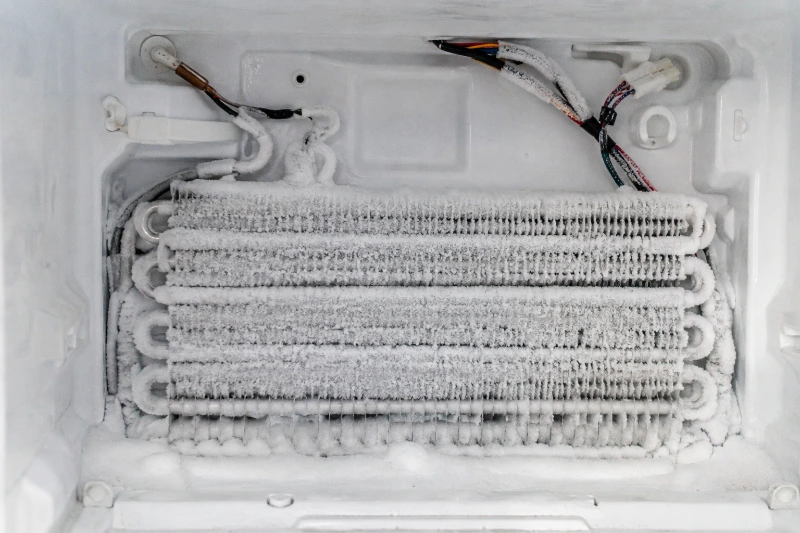
One of the most common causes of this specific problem. If the defrost system isn’t cycling properly (bad defrost timer, defrost thermostat, or heater element), frost builds up on the coil until it’s essentially insulated in ice and can’t transfer cold air anymore.
Failed Evaporator Fan Motor
The coil might be cold, but if the fan that pushes air past it has died or is jammed with frozen ice buildup, nothing moves into the fridge compartment.
Stuck or Broken Air Damper
This little flap controls how much cold air enters the fresh food section. If it’s stuck shut, or the control board isn’t telling it to open, the fridge starves for cold air even though everything upstream is working.
Defrost System Failure
A failed defrost heater, thermostat, sensor, or control can allow frost to keep building on the evaporator coil. Once the coil becomes heavily iced over, cold air can’t circulate properly and the refrigerator section may start running warm.
Blocked Air Duct
Food packaging pushed up against the vents in the back of the fridge, or a frost blockage, can choke off airflow entirely.
Pull everything off the back wall and shelves near the vents inside the fridge compartment. If items are jammed right up against the vents, that alone can cause exactly this symptom. Clear a few inches of space and give it 12–24 hours before assuming it’s mechanical.
Freezer Is Cold but Fridge Is Warm: What Should You Check?
The pattern you notice can provide a useful clue about why the refrigerator section is warm. Use the table below to narrow down the most likely area to inspect before deciding whether the refrigerator needs professional diagnosis.
| What You Notice | Possible Cause | What to Check |
|---|---|---|
| Heavy frost on the freezer back wall | Defrost problem | Look for ice or frost covering the freezer’s rear panel. |
| No airflow into the refrigerator | Evaporator fan or air damper | Listen for the fan and make sure the refrigerator vents are not blocked. |
| One area is cold while another stays warm | Airflow restriction | Check the vents, air passages, and damper for blockage or restricted airflow. |
| Fan runs but the refrigerator stays warm | Frost, airflow, or defrost issue | Check for excessive frost and restricted airflow around the evaporator area. |
| Clicking with poor cooling | Start, control, or compressor issue | A professional diagnosis can help determine whether the problem is electrical or related to the sealed system. |
Important: These symptoms can overlap. A refrigerator may have more than one issue, so the symptom alone does not confirm which component has failed.
How Can You Tell Which Part Is Actually Failing?
You don’t need to be a technician to narrow it down, but you do need to listen and look carefully.
Open the freezer door and listen for a low humming or whirring sound coming from behind the back panel. If the fridge light stays on with the door open (most models), the fan should also be running. Silence there usually points to a dead fan motor — sometimes it’s just glued shut with frost, which brings us to the next check.
The quickest way to tell the two apart: if the freezer is still reaching a normal freezer temperature and freezing food solid, the compressor and sealed refrigerant system are almost certainly working fine — a failed compressor would mean both the freezer and fridge lose cooling together, not just one side. An airflow problem (frozen coil, dead fan, stuck damper, blocked duct) is far more likely whenever the freezer side is still doing its job normally.
Most freezers have a removable back panel (screws, usually four to six of them) that exposes the evaporator coil. If you’re comfortable pulling it off with the unit unplugged, a solid sheet of frost or ice covering the coil confirms a defrost system failure. This is one of the more repair-friendly issues we see — often a defrost heater, thermostat, or timer, not a compressor or sealed-system problem.
A clicking, buzzing, or grinding sound in the weeks before the fridge side went warm is often the fan motor struggling before it finally gives out. If that sounds familiar, our guide on unusual refrigerator noises covers what those specific sounds usually mean.
Can You Fix a Refrigerator That Is Not Cooling Yourself?
A few things are genuinely DIY-safe: clearing vent blockages, giving the unit a manual defrost (unplug it, prop both doors open, let it sit 24–48 hours, then plug back in and see if it recovers), and checking that the thermostat/temperature dial hasn’t been bumped to a low setting.
If a manual defrost temporarily fixes it and the problem comes back within a week or two, that’s a strong sign that the defrost system itself — not just a one-time ice buildup — is the underlying issue, and that part usually isn’t a simple swap without pulling the unit apart and testing components with a multimeter.
Things You Can Check
- Clearing blocked refrigerator vents
- Manually defrosting the unit
- Checking the thermostat or temperature dial
When to Call for Help
Evaporator fan motors, defrost heaters, and control boards involve partial disassembly of the freezer compartment and, in some cases, working near the sealed refrigerant system. That’s where we’d rather come take a look than have someone guess at a part number and order the wrong one.
We can usually tell you what’s wrong over the phone. Same-day appointments available across Westminster, Broomfield, and Arvada.
Does This Look Different on a Side-by-Side vs. a Bottom-Freezer Model?
The underlying mechanism is similar across configurations, but where the airflow path runs, and how hard it is to inspect, changes by layout.
Side-by-Side Refrigerators
On a side-by-side, the duct system runs vertically along one wall, which means a blockage or frost buildup often shows up as uneven cooling — one shelf ice-cold, the next one up noticeably warmer — before the whole compartment goes warm. If you’re seeing that kind of gradient rather than uniform warmth, it’s still the same root causes (fan, damper, frozen coil), just caught a bit earlier in the failure.
Bottom-Freezer and French Door Models
These push air upward from the bottom-mounted freezer into the fridge compartment above, working against gravity more than a top-freezer design does. That makes a weak or failing evaporator fan more noticeable sooner — there’s less passive airflow to fall back on if the fan output drops, so these models often show the “fridge warm” symptom faster once the fan starts to go.
Top-Freezer Models
The classic layout, and generally the most straightforward to diagnose — the panel access to the evaporator coil is usually simpler, and gravity actually helps cold air settle downward into the fridge section even with a partially weakened fan, which is part of why these units sometimes limp along longer before someone notices a real problem.
Does Colorado’s Altitude or Climate Actually Affect This?
Westminster sits around 5,400 feet, so altitude and climate are reasonable questions. But for a refrigerator with a cold freezer and warm refrigerator section, airflow, frost buildup, fans, dampers, door seals, and defrost components are usually more useful places to start.
Low Ambient Humidity
Dry air can contribute to moisture loss from rubber and vinyl door gaskets over time. If a gasket loses its seal, warm room air can enter the refrigerator and contribute to frost buildup and cooling problems.
That’s why checking the door gasket and seal is worthwhile when diagnosing a “freezer cold, fridge warm” problem.
How Do You Check If a Door Gasket Has Failed?
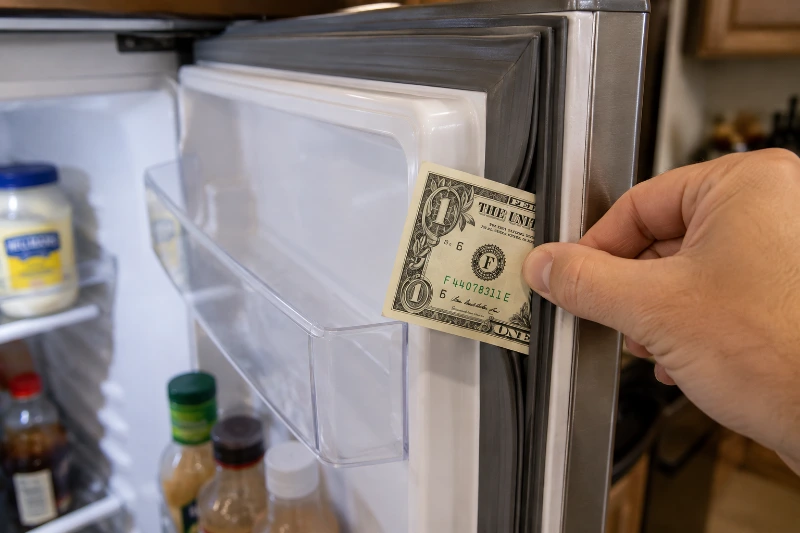
Close the door on a piece of paper or a dollar bill so it’s held at the seal point, then pull it out. If it slides out with little to no resistance anywhere around the door’s perimeter, the gasket isn’t sealing properly there.
Check all four sides and both top corners — gaskets often fail unevenly rather than all at once.
How Much Does Refrigerator Repair Cost?
Depends entirely on which part failed, but here’s what we’re typically quoting on this specific symptom:
Defrost Thermostat or Heater Replacement
A common repair when a failed defrost component is causing the evaporator coil to ice over.
Evaporator Fan Motor Replacement
Air Damper / Control Replacement
Depending on whether it’s a simple mechanical damper or an electronically controlled one.
Door Gasket Replacement
Varies by door size.
We’ll always diagnose first and give you one firm number before starting — these ranges are just to help you know roughly what you’re looking at going in. Dealing with this on a Samsung fridge specifically? Our Samsung refrigerator repair page covers model-specific issues we see most often.
Dealing with a different symptom, like an ice maker that’s stopped producing ice? That’s usually a separate issue from cooling problems and worth diagnosing on its own.
Curious what a bigger repair like a compressor replacement cost runs, or whether it’s smarter to weigh repair or replacement at this point? Both are worth a look before you decide how to move forward.
We can usually tell you what’s wrong over the phone. Same-day appointments available across Westminster, Broomfield, and Arvada.
Frequently Asked Questions
A few of the questions homeowners commonly ask when the freezer is still cold but the refrigerator section isn’t. For more, see our full refrigerator repair FAQ.
A few days usually won’t turn a fan motor into a compressor problem, since the two systems are largely separate. But the longer a frozen evaporator coil sits iced over, the more strain it puts on the defrost heater and surrounding wiring, and food safety becomes the bigger concern well before the mechanical damage does. If the fridge side has been above 40°F for more than a couple hours, treat perishables accordingly.
No — a manual defrost is one of the safest troubleshooting steps there is. Just place towels down to catch the meltwater, and don’t force any ice off with a sharp tool, since that can puncture the evaporator coil and turn a fan repair into a full sealed-system replacement.
Depends on the age and brand — most full-unit warranties run one year, though sealed-system components (compressor, coils) often carry longer coverage, five to ten years on some models. Worth checking your model number and purchase date before paying out of pocket for a covered part.
Not directly — evaporator and defrost failures are mechanical, not climate-driven. What we do see more of here is door seals drying out faster in our low-humidity air, which makes the fridge work harder and can accelerate frost buildup on the coil over time.