Ice Maker Not Making Ice? Troubleshooting Guide
An ice maker that suddenly stops making ice doesn’t always mean a failed part. In many cases, the cause is something simple you can check in a few minutes without any tools. If you’ve already noticed other refrigerator problems, you can also see our Westminster refrigerator repair services we cover before deciding what to check next. Here’s the order we’d check things before replacing a part.
Ice maker issues can also show up a little differently depending on the brand. We regularly work on Samsung refrigerators, LG refrigerators, and Whirlpool & KitchenAid models across Westminster — worth a look if you want brand-specific notes.
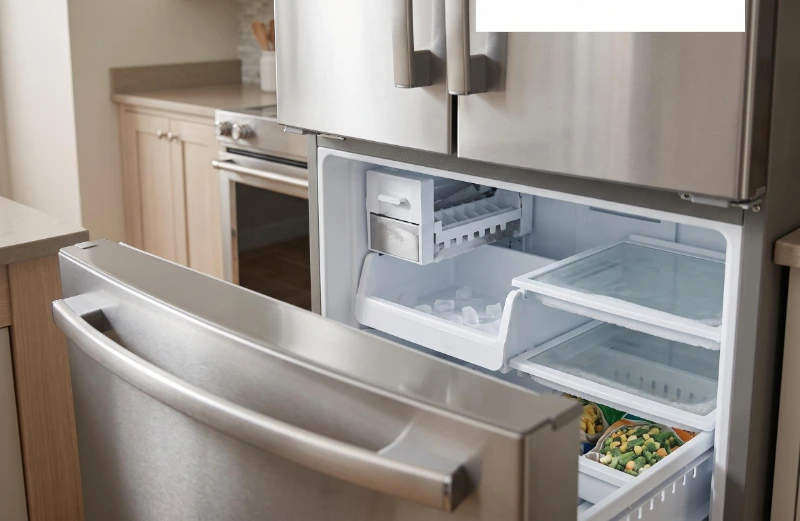
What’s the First Thing to Check When the Ice Maker Stops?
Check These Three Things Before Replacing a Part
Is the ice maker’s own power switch or arm in the “on” position?
Sounds obvious, but a lot of ice makers have a small toggle switch or a wire “shutoff arm” that gets bumped off — often by a bag of frozen peas leaning against it — and it looks identical to “broken” from a user’s perspective.
Is the freezer actually cold enough?
Many ice makers work best when the freezer is near 0°F; the exact operating range can vary by model. If your freezer’s running warm, that’s a different (and related) problem — check our guide on refrigerator cooling problems if the freezer itself feels off.
Is the water supply line turned on at the source?
Behind or under the fridge, there’s a small shutoff valve on the water line. If it got bumped closed — during a move, a floor cleaning, or a DIY project nearby — the ice maker has no water to work with at all.
Ice Maker Not Getting Water? Common Causes to Check
If the ice maker is not filling with water, start with the supply before assuming the ice maker itself has failed. Check that the refrigerator’s water shutoff valve is fully open and that the visible supply line is not kinked, pinched, or damaged. Avoid pulling the refrigerator out if doing so could strain the line.
If your refrigerator has a water dispenser, check whether it is flowing normally. A slow or non-working dispenser as well as an ice maker that is not filling can point to a shared water-supply restriction or filter issue. If the dispenser works normally, the problem may still be in the ice maker’s fill tube, inlet valve, or controls; continue with the checks below.
Why Is the Ice Maker Running But Not Producing Ice?
This is a different symptom from a completely silent unit, and it usually points somewhere more specific.
Is Low Water Pressure Stopping the Ice Maker?
The water inlet valve needs adequate supply pressure to deliver water to the ice maker, but the required pressure varies by refrigerator model. Check the manufacturer’s specifications rather than relying on one pressure figure for every unit. If the household supply is weak or water flow has dropped, the ice maker may produce small or hollow cubes or stop filling altogether. A technician can test the supply and valve if the basic checks do not identify the cause.
Is the Fill Tube Frozen?
Between the water valve and the ice mold, there’s a small tube that fills each batch. If that tube develops a partial ice blockage (common when a freezer’s internal temperature fluctuates), water can’t reach the mold even though the valve itself works fine.
Is a Clogged Water Filter Preventing Ice Production?
A clogged water filter is a common and easy-to-check cause of restricted water flow. Most manufacturers recommend replacing it every 6 months; a fully clogged filter can restrict flow enough to stall ice production even though everything else is working correctly.
What Does Your Ice Maker Symptom Point To?
If you’re not sure where to start, match what you’re seeing with the closest symptom below.
Completely Silent
Start with the power switch, shutoff arm, and freezer temperature.
Check power firstRunning But No Ice
Check the water supply, inlet valve, filter, and fill tube.
Check water flowMotor Tries but Doesn’t Cycle
The ice maker module or harvest cycle may be the problem.
Check the moduleSmall or Hollow Cubes
Restricted water flow can point toward pressure, filter, or valve problems.
Check water pressureIce Maker Problems: What Should You Check?
The symptom you notice can help narrow down where the problem may be. Use the table below to identify the most likely area to check before replacing a part.
| What You Notice | Possible Cause | What to Check |
|---|---|---|
| Ice maker is completely silent | Power, shutoff arm, or module | Check the ice maker switch, shutoff arm, freezer temperature, and test button if equipped. |
| Ice maker runs but no ice is produced | Water supply, inlet valve, filter, or fill tube | Check the water supply, filter, inlet valve, and fill tube for restricted flow or ice buildup. |
| Fill tube appears frozen | Restricted water flow or temperature issue | Look for ice blocking the fill tube and follow the manufacturer’s instructions for safely thawing it. |
| Small or hollow ice cubes | Restricted water flow | Check the water filter, household water supply, and inlet valve for reduced flow. |
| Ice maker does not harvest or eject ice | Ice maker module or harvest mechanism | Check whether the ice maker begins its harvest cycle and whether the motor attempts to operate. |
| Ice production is very slow | Temperature or water-flow problem | Check freezer temperature, water supply, filter condition, and airflow around the freezer compartment. |
Keep in mind: These symptoms can overlap. A single symptom does not always identify the failed component, so diagnosis may require checking more than one part of the ice-making system.
How Do You Know If the Ice Maker Module Has Failed?
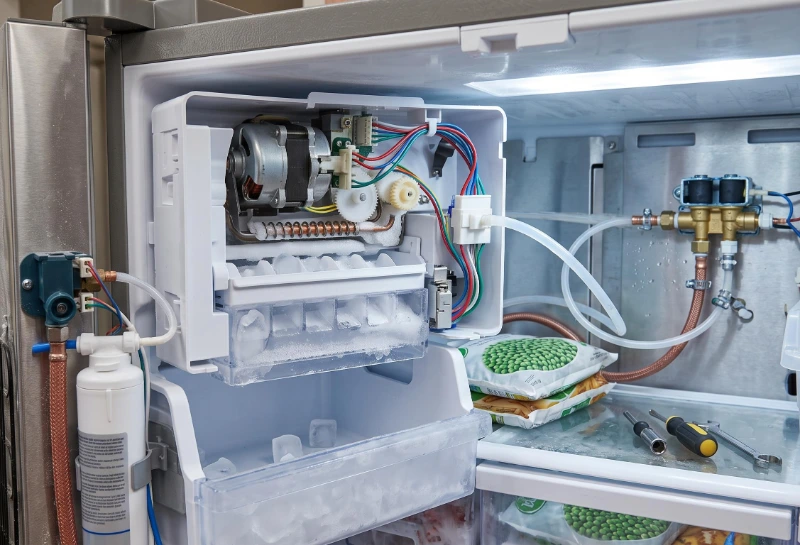
If water supply, pressure, and the fill tube all check out and it’s still not cycling, the ice maker module (the motor and control unit that runs the harvest cycle) may have failed. A few signs point this way:
-
✓
The ice maker doesn’t attempt to cycle at all, even manually triggered via the test button most modules have
-
✓
You hear a motor trying to run but nothing happens (harvest cycle jammed)
-
✓
A temperature sensor, thermostat, or control component may be faulty, depending on the ice maker design
Ice maker modules are a common point-of-failure part, and on most models they’re a self-contained unit that can be swapped without touching the sealed refrigerant system — one of the more straightforward repairs in terms of cost and time compared to compressor or sealed-system work.
What About Ice That Tastes or Smells Off?
Different issue, same general area of the fridge, so worth covering here. Ice sitting for weeks can pick up freezer odors, but a persistent off-taste usually means the water filter is overdue, or the ice bin itself needs a wash — plastic bins can harbor buildup over time, especially if ice sits unused for long stretches (like after a vacation).
If your fridge has also started making an unusual sound recently, it’s worth a quick look at our guide on refrigerator buzzing or clicking noises — sometimes an ice maker issue and a noise complaint trace back to the same worn part.
Replace an overdue filter, wash the ice bin, and discard old ice before assuming a mechanical problem.
Still Not Making Ice After Checking the Basics?
Let’s take a proper look. Same-day appointments available across Westminster, Broomfield, and Arvada.
Call (720) 783-1707 →Frequently Asked Questions
A few of the questions homeowners commonly ask when an ice maker suddenly stops producing ice. Have a different question? Check our refrigerator repair FAQ page.
A working dispenser does not rule out an ice-maker-specific problem. The fill tube may be frozen, the ice maker’s inlet valve circuit may not be opening, the ice maker may be switched off, or its module may not be completing the harvest cycle. Check the freezer temperature and ice maker switch first, then follow the model-specific troubleshooting instructions.
Common causes include a closed shutoff valve, a kinked supply line, a restricted filter, a frozen fill tube, or a faulty water inlet valve. If the water dispenser is also slow or not working, check the shared water supply and filter first. If the dispenser works normally, the issue may be limited to the ice maker’s fill path or controls.
Timing varies by model, but a newly installed or reset ice maker may need several hours—and sometimes up to 24 hours—to begin producing a full batch. Check the owner’s manual for the expected startup time. If it still has not made ice after that period, recheck the water supply and freezer temperature.
Only do this if your refrigerator supports a manufacturer-approved bypass plug or bypass mode. Follow the owner’s manual; do not force the filter out or leave the system without filtration if the model requires a filter or bypass plug. If water flow improves with the approved bypass, the filter or filter housing may be restricting flow, but further checking may be needed to confirm the cause.
The total depends on the refrigerator model, the part, and labor rates. It is generally a different type of repair from sealed-system work because the inlet valve does not require opening the refrigerant circuit, but get a diagnosis and quote before approving replacement.
Several issues can cause a sudden stop, including the shutoff arm or power switch being moved, a blocked water supply, a frozen fill tube, a failed inlet valve, or a problem with the ice maker’s harvest mechanism. Check the simple water and temperature items first; a symptom alone cannot confirm which part has failed.